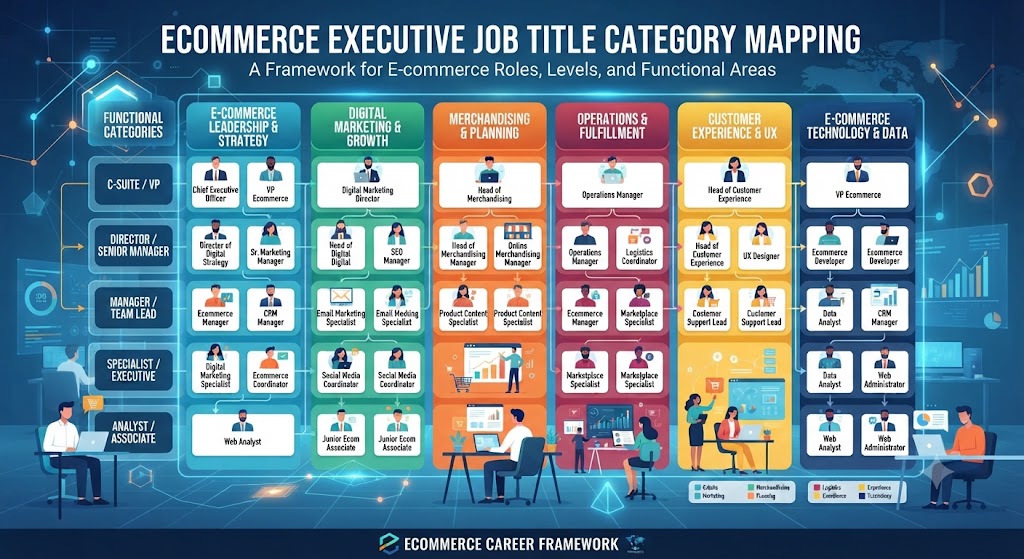
Introduction: Understanding Ecommerce Executive Job Title Category Mapping
Ecommerce executive job title category mapping is the process of organizing digital commerce roles into clear categories based on responsibilities, seniority levels, business functions, and strategic ownership. As ecommerce teams become more complex, companies need a structured way to define positions ranging from entry-level ecommerce executives to senior ecommerce directors and chief digital officers.
A decade ago, ecommerce teams were often small. One person might manage product uploads, online orders, customer queries, and basic marketing campaigns. Today, ecommerce operations involve multiple specialists covering marketplace management, conversion optimization, ecommerce analytics, digital merchandising, customer experience, fulfillment strategy, and revenue growth.
This expansion has created hundreds of job titles. Two companies may use completely different names for similar roles. For example, an Ecommerce Growth Manager, Digital Commerce Manager, and Online Sales Manager may perform overlapping responsibilities depending on the organization.
A proper ecommerce executive job title category mapping framework helps recruiters, businesses, candidates, and HR teams understand where each role fits within the broader ecommerce ecosystem.
This guide explains how ecommerce positions are categorized, what responsibilities belong to each level, and how companies can create a scalable ecommerce career structure.
What Is Ecommerce Executive Job Title Category Mapping?
Ecommerce executive job title category mapping refers to the classification of ecommerce-related job titles into logical groups based on their business impact, operational responsibilities, and decision-making authority.
Instead of looking at job titles individually, mapping focuses on the actual function behind each position.
For example:
| Job Title | Category | Primary Responsibility |
|---|---|---|
| Ecommerce Executive | Ecommerce Operations | Daily online store management |
| Ecommerce Specialist | Digital Commerce Support | Product, catalog, and campaign execution |
| Ecommerce Manager | Ecommerce Strategy | Revenue and channel growth |
| Ecommerce Director | Leadership | Business-wide ecommerce performance |
| Chief Digital Officer | Executive Leadership | Digital transformation strategy |
The purpose is not only to organize titles but also to create a clear relationship between roles.
A strong mapping system answers questions such as:
- What does an Ecommerce Executive actually do?
- Which roles report to an Ecommerce Manager?
- What skills are required for promotion?
- How should companies structure ecommerce departments?
- Which titles represent operational versus strategic responsibilities?
Why Ecommerce Job Title Mapping Matters for Modern Businesses
Ecommerce has moved beyond simply selling products online. Modern digital commerce combines technology, marketing, customer experience, logistics, and data analysis.
Without clear job title categories, companies often face problems such as:
- Overlapping responsibilities between employees
- Confusing career progression
- Poor recruitment decisions
- Incorrect salary benchmarking
- Difficulty building specialized teams
A well-designed ecommerce executive job title category mapping structure creates clarity.
Benefits of Ecommerce Role Classification
1. Better Recruitment Accuracy
Recruiters can identify whether they need an operational employee, technical specialist, growth expert, or strategic leader.
For example:
A company looking for someone to manage Shopify product listings should not advertise for a “Digital Commerce Strategist.” The responsibilities do not match the seniority or skill requirements.
2. Clear Employee Career Growth
Employees understand what skills they need to move from one level to another.
A typical ecommerce career path may look like:
Ecommerce Assistant → Ecommerce Executive → Ecommerce Specialist → Ecommerce Manager → Ecommerce Director → VP Ecommerce
Each stage requires increased ownership and strategic thinking.
3. Improved Team Structure
Large ecommerce companies often separate teams into specialized departments:
- Ecommerce Operations
- Digital Marketing
- Marketplace Management
- Conversion Rate Optimization
- Ecommerce Technology
- Customer Experience
- Analytics and Reporting
Job title mapping ensures every function has clear ownership.
Main Categories in Ecommerce Executive Job Title Mapping
The ecommerce industry contains multiple career tracks. A single title does not always describe the complete role. The following categories provide a practical framework.
1. Ecommerce Operations Job Titles
The operations category focuses on managing the daily activities required to keep an online store running smoothly.
These professionals handle product management, order processes, inventory coordination, and platform maintenance.
Common Ecommerce Operations Titles
- Ecommerce Assistant
- Ecommerce Executive
- Ecommerce Coordinator
- Ecommerce Specialist
- Ecommerce Operations Manager
- Ecommerce Operations Director
Ecommerce Executive Role Category
An Ecommerce Executive is usually an early-to-mid career position responsible for executing daily ecommerce activities.
Typical responsibilities include:
- Updating product listings
- Managing website content
- Monitoring online orders
- Coordinating promotions
- Supporting marketplace operations
- Preparing sales reports
- Checking website accuracy
The role requires strong attention to detail because small mistakes in ecommerce operations can directly affect revenue.
A missing product image, incorrect price, or outdated inventory status can create customer frustration and lost sales.
Ecommerce Specialist Job Category
An Ecommerce Specialist usually has deeper platform knowledge compared with an Ecommerce Executive.
They may manage:
- Shopify, Magento, WooCommerce, or Salesforce Commerce Cloud platforms
- Product information management systems
- Website merchandising
- Conversion improvements
- Ecommerce reporting tools
This role often acts as the connection between daily operations and strategic ecommerce improvements.
2. Ecommerce Management and Leadership Roles
Management positions focus less on execution and more on strategy, performance improvement, and team leadership.
These roles own revenue targets, customer growth, and channel expansion.
Ecommerce Manager Job Category
An Ecommerce Manager is responsible for improving online sales performance and managing ecommerce activities across multiple channels.
Common responsibilities include:
- Developing ecommerce growth strategies
- Managing website performance
- Increasing conversion rates
- Coordinating marketing campaigns
- Managing ecommerce teams
- Analyzing customer behavior
- Improving customer journey
An Ecommerce Manager typically works with marketing, technology, finance, and supply chain teams.
Senior Ecommerce Manager
A Senior Ecommerce Manager handles larger business decisions.
They may own:
- Revenue forecasting
- Expansion into new markets
- Marketplace growth
- Digital transformation projects
- Strategic partnerships
This position requires both analytical ability and commercial thinking.
A successful senior ecommerce leader understands not only website performance but also profitability, customer lifetime value, and operational efficiency.
3. Ecommerce Marketing and Growth Job Categories
Many ecommerce companies separate growth responsibilities from operational management.
These roles focus on attracting customers and increasing revenue.
Ecommerce Growth Manager
An Ecommerce Growth Manager focuses on scaling online revenue through experimentation and optimization.
Key responsibilities include:
- Conversion rate optimization (CRO)
- Customer acquisition strategy
- Paid advertising coordination
- Email marketing optimization
- Funnel analysis
- A/B testing
They combine marketing knowledge with ecommerce analytics.
Digital Commerce Marketing Roles
Related job titles include:
- Ecommerce Marketing Manager
- Digital Commerce Specialist
- Online Merchandising Manager
- Ecommerce Acquisition Manager
- Lifecycle Marketing Manager
These positions focus on increasing traffic, engagement, and customer retention.
4. Marketplace Ecommerce Job Titles
Marketplace businesses such as Amazon, Walmart Marketplace, and regional platforms have created specialized ecommerce careers.
Marketplace professionals manage third-party sales channels.
Common Marketplace Roles
- Marketplace Executive
- Marketplace Specialist
- Amazon Account Manager
- Marketplace Manager
- Marketplace Director
Responsibilities often include:
- Product listing optimization
- Marketplace advertising
- Seller account management
- Pricing strategy
- Inventory planning
- Competitor analysis
A marketplace specialist requires different expertise from a traditional website ecommerce manager because each platform has its own algorithms, ranking systems, and customer behavior patterns.
Continue to Part 2:
- Ecommerce technology and analytics roles
- Executive-level ecommerce hierarchy
- Complete ecommerce title hierarchy chart
- Skills required by each level
- How companies should map ecommerce careers
- FAQ section
- Final conclusion and action steps
Ecommerce Executive Job Title Category Mapping: Complete Guide to Roles, Levels, and Career Paths (Part 2)
5. Ecommerce Technology and Platform Management Job Categories
Modern ecommerce businesses depend heavily on technology platforms, integrations, automation systems, and data infrastructure. Because of this, many companies create dedicated technology-focused ecommerce positions.
These roles sit between business teams and technical teams.
A person working in ecommerce technology does not necessarily write code every day. Instead, they ensure that ecommerce platforms support business goals.
Ecommerce Platform Manager
An Ecommerce Platform Manager is responsible for managing the technology foundation behind an online store.
Typical responsibilities include:
- Managing ecommerce platforms such as Shopify, Magento, WooCommerce, or Salesforce Commerce Cloud
- Coordinating platform updates
- Managing integrations with payment gateways and CRM systems
- Improving website functionality
- Working with developers and agencies
- Monitoring technical performance
This role is common in companies where ecommerce revenue is a major business channel.
Ecommerce Product Manager
An Ecommerce Product Manager focuses on improving the digital shopping experience.
Unlike traditional product managers who manage physical products, ecommerce product managers manage the online customer experience.
Their responsibilities include:
- Website feature development
- Checkout optimization
- Mobile shopping improvements
- User experience research
- Customer journey mapping
- Prioritizing development projects
They often work closely with:
- UX designers
- Developers
- Data analysts
- Ecommerce managers
Ecommerce Solutions Manager
This role focuses on finding and implementing technology solutions that improve ecommerce operations.
Examples include:
- Implementing new ecommerce platforms
- Connecting ERP and inventory systems
- Automating workflows
- Improving customer data management
This position is usually found in larger organizations.
6. Ecommerce Analytics and Data Job Title Categories
Data has become one of the most important parts of ecommerce decision-making.
Companies now rely on analytics teams to understand customer behavior, sales trends, and business performance.
Ecommerce Analyst
An Ecommerce Analyst converts ecommerce data into actionable business insights.
Common responsibilities include:
- Tracking website performance
- Monitoring conversion rates
- Analyzing sales trends
- Measuring campaign performance
- Creating dashboards
- Identifying customer behavior patterns
Important tools for this role include:
- Google Analytics 4
- Adobe Analytics
- Tableau
- Power BI
- Looker Studio
- SQL databases
Ecommerce Data Analyst
An Ecommerce Data Analyst has stronger technical skills and focuses heavily on data processing.
Responsibilities may include:
- Building analytical models
- Creating automated reports
- Measuring customer lifetime value
- Predicting purchasing behavior
- Supporting pricing decisions
This role connects ecommerce strategy with data science.
Ecommerce Insights Manager
An Ecommerce Insights Manager leads analytics initiatives and helps leadership make better decisions.
They may analyze:
- Customer segmentation
- Product performance
- Revenue opportunities
- Market trends
- Retention strategies
This position is usually a senior-level analytical role.
7. Ecommerce Customer Experience Job Categories
Customer expectations have changed dramatically. Ecommerce success is no longer only about attracting visitors. Businesses must also create smooth purchasing experiences.
Customer experience roles focus on improving every interaction between customers and brands.
Ecommerce Customer Experience Manager
An Ecommerce Customer Experience Manager manages the online shopping journey.
Responsibilities include:
- Improving website usability
- Reducing checkout problems
- Improving customer satisfaction
- Analyzing customer feedback
- Coordinating support improvements
Key performance indicators may include:
- Customer satisfaction score (CSAT)
- Net promoter score (NPS)
- Cart abandonment rate
- Repeat purchase rate
Ecommerce Conversion Rate Optimization (CRO) Specialist
A CRO Specialist focuses on increasing the percentage of website visitors who complete desired actions.
Their work includes:
- Running A/B tests
- Improving landing pages
- Optimizing product pages
- Studying user behavior
- Testing checkout improvements
For many ecommerce companies, improving conversion rate is more profitable than simply increasing traffic.
8. Ecommerce Merchandising Job Title Categories
Ecommerce merchandising combines product strategy with customer behavior analysis.
These professionals decide how products appear online and how customers discover them.
Ecommerce Merchandiser
An Ecommerce Merchandiser manages the presentation of products on digital channels.
Responsibilities include:
- Product categorization
- Search optimization
- Product placement
- Promotional planning
- Seasonal campaigns
- Pricing coordination
The goal is simple:
Help customers find the right products faster.
Digital Merchandising Manager
A Digital Merchandising Manager manages broader online product strategy.
They focus on:
- Improving product discovery
- Increasing average order value
- Managing online promotions
- Creating merchandising strategies
This role is especially important for fashion, retail, beauty, and consumer product companies.
Complete Ecommerce Executive Job Title Hierarchy
A clear hierarchy helps companies understand how ecommerce careers develop.
Entry-Level Ecommerce Roles
These positions focus on learning operations and supporting daily activities.
Common titles:
- Ecommerce Assistant
- Ecommerce Intern
- Ecommerce Coordinator
- Ecommerce Associate
Typical responsibilities:
- Product updates
- Basic reporting
- Order management
- Content updates
- Customer support assistance
Mid-Level Ecommerce Roles
These professionals manage specific ecommerce functions.
Common titles:
- Ecommerce Executive
- Ecommerce Specialist
- Ecommerce Analyst
- Marketplace Specialist
- Ecommerce Coordinator
Responsibilities:
- Managing ecommerce channels
- Improving processes
- Running campaigns
- Analyzing performance
- Supporting business growth
Senior-Level Ecommerce Roles
These roles involve strategy and leadership.
Common titles:
- Ecommerce Manager
- Senior Ecommerce Manager
- Ecommerce Growth Manager
- Head of Ecommerce
Responsibilities:
- Revenue ownership
- Team management
- Strategic planning
- Channel expansion
- Performance optimization
Executive Ecommerce Leadership Roles
These positions manage ecommerce at a company-wide level.
Common titles:
- Ecommerce Director
- Head of Digital Commerce
- VP Ecommerce
- Chief Digital Officer
- Chief Ecommerce Officer
Responsibilities:
- Defining ecommerce vision
- Managing large budgets
- Leading digital transformation
- Driving company growth
Ecommerce Executive Job Title Category Mapping by Business Function
A practical way to organize ecommerce roles is by department.
| Category | Example Job Titles | Main Focus |
|---|---|---|
| Operations | Ecommerce Executive, Ecommerce Coordinator | Daily store management |
| Growth | Ecommerce Growth Manager, Acquisition Manager | Revenue growth |
| Marketing | Ecommerce Marketing Manager | Customer acquisition |
| Marketplace | Marketplace Specialist, Amazon Manager | Third-party channels |
| Technology | Platform Manager, Ecommerce Product Manager | Ecommerce systems |
| Analytics | Ecommerce Analyst, Data Analyst | Data-driven decisions |
| Experience | CX Manager, CRO Specialist | Customer journey |
| Leadership | Ecommerce Director, VP Ecommerce | Business strategy |
Skills Required Across Ecommerce Job Levels
A strong ecommerce professional needs a combination of business, technical, and analytical skills.
Entry-Level Skills
Professionals entering ecommerce should develop:
- Product management basics
- Excel and spreadsheet skills
- Ecommerce platform knowledge
- Basic SEO understanding
- Customer service experience
Mid-Level Skills
Ecommerce specialists and executives should understand:
- Google Analytics
- Conversion optimization
- Paid advertising fundamentals
- Marketplace operations
- Inventory management
- Reporting dashboards
Senior-Level Skills
Ecommerce managers and directors require:
- Strategic planning
- Budget management
- Leadership abilities
- Revenue forecasting
- Customer lifecycle strategy
- Digital transformation knowledge
How Companies Should Build an Ecommerce Job Title Framework
A common mistake businesses make is creating titles without defining responsibilities.
A better approach is to create a structured framework.
Step 1: Identify Ecommerce Functions
Start by defining business areas:
- Store operations
- Marketing
- Technology
- Analytics
- Customer experience
- Marketplace management
Step 2: Define Seniority Levels
Create clear levels:
- Assistant
- Executive
- Specialist
- Manager
- Senior Manager
- Director
- Executive Leadership
Step 3: Match Responsibilities With Authority
Titles should represent actual decision-making power.
For example:
An employee managing product uploads should not have the same title as someone controlling ecommerce revenue strategy.
Clear mapping improves:
- Recruitment
- Employee development
- Salary benchmarking
- Organizational planning
Frequently Asked Questions About Ecommerce Executive Job Title Category Mapping
1. What is ecommerce executive job title category mapping?
Ecommerce executive job title category mapping is the process of organizing ecommerce-related positions into categories based on responsibilities, seniority, and business functions.
It helps companies understand how different ecommerce roles connect and how employees can progress through their careers.
2. What level is an Ecommerce Executive position?
An Ecommerce Executive is generally a junior-to-mid-level ecommerce role.
The position usually focuses on executing ecommerce activities such as product management, website updates, reporting, and operational support.
With experience, an Ecommerce Executive can progress into roles like Ecommerce Specialist, Ecommerce Manager, or Marketplace Manager.
3. What is the difference between an Ecommerce Executive and Ecommerce Manager?
An Ecommerce Executive usually handles daily execution, while an Ecommerce Manager focuses on strategy and team leadership.
An Ecommerce Executive may update products and monitor orders, whereas an Ecommerce Manager may manage revenue targets, campaigns, budgets, and business growth strategies.
4. Which ecommerce job titles are most in demand?
Some highly demanded ecommerce roles include:
- Ecommerce Manager
- Ecommerce Growth Manager
- Marketplace Manager
- Ecommerce Analyst
- Ecommerce Product Manager
- Conversion Rate Optimization Specialist
- Ecommerce Operations Manager
Demand continues to increase as businesses invest more heavily in digital sales channels.
5. How do companies decide ecommerce job titles?
Companies should decide ecommerce job titles based on:
- Scope of responsibility
- Decision-making authority
- Team leadership
- Revenue ownership
- Required technical skills
A job title should accurately represent the role rather than simply sound impressive.
Conclusion: Building a Better Ecommerce Career and Organization Structure
A well-designed ecommerce executive job title category mapping system creates clarity for both businesses and professionals.
For companies, it improves recruitment, team organization, and long-term digital growth planning. For professionals, it creates a clear career roadmap from entry-level ecommerce roles to executive leadership positions.
The ecommerce industry will continue expanding as businesses invest in online sales, marketplaces, automation, and customer experience. Organizations that clearly define their ecommerce roles will be better positioned to build efficient teams and compete in a rapidly changing digital environment.
The next step for businesses is to review their current ecommerce structure, identify missing functions, and create a role framework that matches their growth goals. For professionals, understanding this mapping helps identify the skills and experiences needed to move into higher-value ecommerce positions.