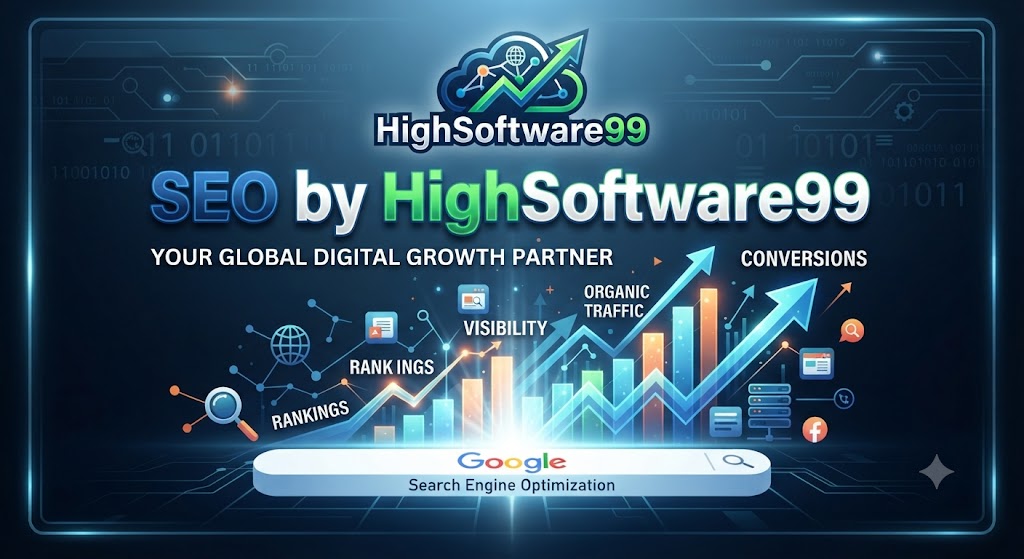
The phrase seo by highsoftware99.com refers to an online service associated mainly with Google Autocomplete visibility. Its website promotes the ability to make selected keywords appear in Google search suggestions, sometimes within a claimed period of 3 to 12 hours. That is very different from ranking a website on the first page of organic search results.
This distinction matters because several articles discussing the service describe it as a complete SEO platform, an indexing tool, a content optimisation system, or even a general digital marketing agency. The available public information does not clearly establish all those descriptions. The most visible claim connected with the official domain concerns Google Autocomplete, also referred to as ATC.
This article explains what the service appears to offer, how autocomplete works, what “instant appear” may actually mean, and how businesses can evaluate the service without confusing search suggestions with organic rankings, indexing, traffic, leads, or revenue.
What Is SEO by HighSoftware99.com?
SEO by HighSoftware99.com appears to be a branded search visibility service that concentrates on associating a business, product, website, or name with particular search terms in Google Autocomplete.
Autocomplete is the list of predicted searches that appears while someone types in Google’s search box. For example, a person typing “best accounting software” may see several longer suggested searches before pressing Enter.
Google explains that these predictions are generated automatically. They are influenced by real searches, common queries, language, location, trending interest and, in some cases, a user’s previous search activity. Predictions can therefore vary between users, countries, devices and periods of time.
The official HighSoftware99.com search listing promotes “Google Auto Complete” or “ATC services” and claims that keywords may be boosted through autocomplete within 3 to 12 hours.
However, the phrase seo by highsoftware99.com should not automatically be interpreted as a recognised SEO methodology. It is better understood as the name of a provider or branded service. There is no established industry standard called the “HighSoftware99 SEO method,” and third-party pages often provide conflicting explanations of what it includes.
Some describe it as conventional technical SEO. Others associate it with automated optimisation, link building, instant indexing, keyword visibility or artificial popularity signals. Those descriptions should not be treated as confirmed unless the provider states them directly in a written proposal.
How the Service Appears to Work
Public information does not provide a complete technical explanation of the service’s methods. The central offer can nevertheless be understood through three concepts.
Targeting a Search Phrase
A client may select a keyword that is relevant to the business. The provider then attempts to make a branded variation appear as an autocomplete prediction.
For example, a cleaning company might want a prediction such as:
“office cleaning services by Example Brand”
The intended benefit is that searchers may notice the brand before reaching the results page.
Building an Association Between a Keyword and Brand
Autocomplete systems use search activity and other signals to determine which predictions are useful. A service targeting autocomplete may attempt to strengthen the association between a generic phrase and a particular brand.
The exact method matters greatly. A legitimate campaign could involve increasing real brand demand through publicity, useful content, advertising, social activity and genuine searches from interested users.
A risky method could involve bots, coordinated artificial searches, automated queries or other manufactured behaviour. Google states that machine-generated traffic includes sending automated queries to Google and that unauthorised automated access violates its spam policies and terms.
Businesses should therefore ask how the association is created rather than accepting a description such as “advanced SEO technology.”
Maintaining the Prediction
Autocomplete predictions are not permanent placements. They may change when search demand, trends, location signals or Google’s systems change.
A prediction that appears today may disappear later. It might also appear in one country but not another. The ongoing value of the service therefore depends on whether the visibility comes from genuine, lasting brand interest or temporary activity that must be repeatedly maintained.
Autocomplete, Indexing and Ranking Are Not the Same
A common problem in articles about SEO by HighSoftware99.com is the use of “visibility,” “indexing,” “ranking” and “autocomplete” as though they mean the same thing.
They represent separate stages and features.
| Search concept | What it means | What it does not prove |
|---|---|---|
| Google Autocomplete | A predicted query shown while a person types | That a website ranks for the query |
| Crawling | Googlebot discovers and downloads a page | That the page will be indexed |
| Indexing | Google processes and stores information about a page | That the page will rank prominently |
| Organic ranking | A page appears in unpaid search results for a query | That the result will generate customers |
| Paid search advertisement | A sponsored placement purchased through Google Ads | That the website has strong organic SEO |
| Search traffic | People click through to a website from search | That the visitors will convert into leads or sales |
Google describes Search as a three-stage process involving crawling, indexing and serving results. It also states that following technical requirements does not guarantee that a page will be crawled, indexed or shown in search results.
A branded autocomplete prediction can therefore exist even when the brand’s website ranks poorly. Likewise, a website may rank well without receiving any special autocomplete prediction.
Does SEO by HighSoftware99.com Improve Google Rankings?
The most accurate answer is that autocomplete visibility alone does not demonstrate an improvement in organic rankings.
A prediction can influence what a user searches. It does not determine which pages Google displays after the search is submitted. Google’s ranking systems evaluate many signals across indexed pages to select useful and relevant results.
Suppose a company succeeds in making its name appear beside a popular service phrase. Several outcomes are possible:
- Users may select the prediction and search for the branded phrase.
- The company’s website may rank because the query contains its exact brand name.
- Users may see third-party pages, reviews, competitors or unrelated results instead.
- The prediction may generate impressions but few clicks.
- Users may click the website but take no commercial action.
This means an autocomplete campaign should be measured separately from normal SEO.
The business should track:
- How often the prediction appears across target locations.
- Whether people select the prediction.
- Changes in branded search impressions.
- Organic clicks for the exact branded query.
- Engagement and conversions after the click.
- Whether visibility continues when the service stops.
- Whether non-branded organic rankings improve independently.
A screenshot showing a prediction is not enough to prove commercial value.
Potential Benefits of Autocomplete Visibility
Autocomplete marketing is not automatically useless. It may provide value in certain situations when the prediction is supported by genuine brand interest and measured carefully.
Greater Brand Recognition
A name displayed beside a relevant search phrase may introduce the brand to users who had not previously considered it. Repeated exposure can improve familiarity.
However, visibility should not be described as an endorsement from Google. Google states that predictions are generated automatically and are not assertions of fact or opinion.
More Branded Searches
A prediction can encourage users to complete a generic query with a particular company name. Branded queries are often less competitive than broad service keywords because the user is already looking for a specific organisation.
Support for Product Launches
Companies launching a new product, event or campaign may use autocomplete visibility as one part of a broader awareness strategy.
Its effectiveness will depend on the audience, search volume, timing and reputation of the brand. A prediction for a phrase that few people type has little practical value.
Reputation Positioning
Autocomplete can shape the phrases people associate with a company. This may be useful when the prediction accurately describes a known product or service.
It becomes problematic when the wording creates a misleading impression, makes an unverified claim or tries to imitate organic public interest.
Limitations and Risks to Consider
No Guaranteed Organic Position
No third-party SEO provider controls Google’s rankings. Google states that it does not accept payment to crawl websites more frequently or rank pages higher. It also does not guarantee crawling, indexing or serving a page, even when a site follows Search Essentials.
A provider can optimise a website and improve its opportunities. It cannot honestly guarantee a permanent organic position.
Predictions Vary by User and Location
Autocomplete results can be affected by language, geographic location, current trends and personal search history.
A prediction shown on the provider’s device may not appear for the intended customer. Testing should therefore cover:
- Signed-out searches.
- Clean browser profiles.
- Different cities and countries.
- Mobile and desktop devices.
- More than one internet connection.
- Several days rather than a single moment.
Incognito mode alone is not a complete neutrality test because location and broader search patterns can still affect suggestions.
Artificial Queries May Create Compliance Risks
A business should be cautious if a provider uses automated searches to manufacture demand. Google’s spam policies classify unauthorised machine-generated queries as automated traffic.
The client should ask directly:
- Are bots used?
- Are automated Google searches generated?
- Are proxy networks involved?
- Are people paid to repeat searches?
- Is traffic simulated?
- Is any software installed on third-party devices?
- Does the provider have Google’s permission for automated access?
Vague answers should be treated as a warning.
Short-Lived Visibility
Autocomplete predictions respond to changing behaviour. A campaign may produce temporary visibility without building durable assets.
Traditional SEO can leave a business with improved content, stronger internal linking, faster pages, useful backlinks and better information architecture. A short autocomplete campaign may leave little behind once the prediction disappears.
Weak Relationship With Revenue
A phrase can look impressive while producing no enquiries. The key issue is not merely whether the brand appears but whether the right customers search, click and convert.
A prediction should be connected to a relevant landing page, accurate messaging and a measurable business objective.
Reputation Risk
Users may be suspicious of an unfamiliar company name inserted into a generic search phrase. The result can look unnatural when there is little independent evidence connecting the brand with the topic.
Before increasing branded searches, businesses should make sure their website, reviews, contact information and service pages are ready for scrutiny.
SEO by HighSoftware99.com Versus Conventional SEO
| Area | Autocomplete-focused service | Conventional SEO |
| Main objective | Influence or gain visibility in search predictions | Improve organic visibility of website pages |
| Primary asset | Branded query association | Website content, authority and technical quality |
| Speed | Predictions may change quickly | Competitive rankings usually develop gradually |
| Measurement | Prediction presence and branded searches | Impressions, rankings, clicks, leads and revenue |
| Geographic consistency | Can vary significantly | Rankings also vary but can be tracked by page and query |
| Long-term value | Depends on continued demand and stability | Can build lasting content and site improvements |
| Main risk | Artificial or temporary search activity | Poor content, spam links or technical mistakes |
| Best role | Experimental brand-awareness channel | Core organic acquisition strategy |
These approaches are not necessarily mutually exclusive. A company may test autocomplete visibility while continuing technical SEO, content development and authority building.
The mistake is treating autocomplete as a replacement for a complete organic strategy.
How to Evaluate the Service Before Paying
1. Request a Written Description of the Method
Ask the provider to explain what actions will be performed. The proposal should distinguish autocomplete work from:
- Website optimisation.
- Link building.
- Content creation.
- Indexing support.
- Reputation management.
- Paid advertising.
- Organic ranking work.
Do not rely on broad terms such as “AI SEO,” “instant appear technology” or “secret algorithm.”
2. Define the Exact Deliverable
A clear agreement should identify:
- The target keyword.
- The branded prediction.
- The countries or cities covered.
- The devices or Google properties included.
- The expected campaign period.
- The verification process.
- The maintenance requirement.
- The refund or correction terms.
“Get visible on Google” is not a measurable deliverable.
3. Ask for Raw Evidence
Case studies should include more than screenshots. Useful evidence may contain:
- Search Console performance data.
- Dates and campaign duration.
- Target markets.
- Baseline and post-campaign branded searches.
- Organic clicks.
- Conversions.
- An explanation of other marketing activity during the same period.
Anonymous screenshots can be edited, personalised or taken in a favourable location. They cannot prove that an average customer saw the same prediction.
4. Protect Account and Website Access
A provider working only on autocomplete should not automatically need full access to hosting, payment systems, customer databases or domain ownership.
Grant the minimum permission required. Use separate accounts, enable multi-factor authentication and document all access.
For Search Console or analytics, use role-based access rather than sharing the main password.
5. Run a Limited Test
Instead of applying the service across every important keyword, begin with one lower-risk campaign.
Record the baseline before starting. Measure the prediction in several locations, monitor branded impressions, and compare qualified conversions with the total cost.
A test is successful only when the outcome supports a business goal, not simply when a phrase appears in a screenshot.
6. Review Exit Conditions
Ask what happens after payment ends.
Will the prediction disappear? Is ongoing activity required? Does the provider retain control over any pages, profiles, links or content? Can the business remove or update campaign assets?
A service that creates permanent dependency may be more expensive than its initial fee suggests.
Frequently Missed Facts About Autocomplete SEO
A Prediction Is a Query, Not a Website Result
Autocomplete recommends wording that a user might search. It does not recommend a particular webpage. After selecting the prediction, the user still sees an independently generated results page.
This is the most important difference competitors often fail to explain.
Personalised Testing Can Produce False Confidence
A person repeatedly searching for the same phrase may influence what appears in their own account or browser. Google says previous searches can contribute to personalised predictions.
Campaign verification should therefore avoid relying on the device used to create or monitor the searches.
Fast Appearance Is Not Fast Indexing
A prediction appearing in hours does not mean a webpage was crawled or indexed in the same period.
Google says a recrawl request can take from days to weeks and does not guarantee inclusion in results. Repeatedly requesting indexing does not make crawling happen faster.
High-Volume Keywords Are Not Always Better
A broad phrase may attract many searches but weak buying intent. A smaller, specific term may generate better leads.
For example, appearing for “marketing company” may produce vague attention. A phrase such as “B2B SaaS marketing agency for cybersecurity firms” could reach fewer but more relevant users.
Search Visibility Can Expose Reputation Problems
More branded searches can also lead users to complaints, outdated profiles, confusing company details or poor reviews.
A business should review its complete branded results page before encouraging additional searches.
Third-Party Mentions Should Be Genuine
Publishing many near-identical articles across unrelated websites can create a temporary impression of popularity, but it may also resemble scaled content or link manipulation.
Google’s spam policies warn against producing large amounts of unoriginal content primarily to manipulate rankings, automated link creation and low-value pages targeting similar searches.
Building a Safer Long-Term Search Strategy
A business considering SEO by HighSoftware99.com should keep its core SEO programme separate from any autocomplete experiment.
A sustainable strategy normally includes:
Technical Accessibility
Pages should be crawlable, render correctly, load reliably and avoid accidental noindex rules. Important pages should be included in logical navigation and XML sitemaps.
Search-Intent Content
Each important page should answer the need behind its target query. A service page should explain deliverables, process, suitability, pricing factors and limitations rather than repeating the keyword.
Google recommends creating content primarily to help people rather than producing pages mainly to attract search visits.
Original Evidence
Case studies, screenshots of real work, product tests, expert commentary, data and clear authorship create information that competitors cannot easily copy.
This is especially important as search systems increasingly summarise information through AI features. Google’s current guidance continues to prioritise valuable, non-commodity content and warns against inauthentic mentions or supposed AI-ranking hacks.
Ethical Authority Building
Links and citations should come from relevant websites that choose to reference the business because the material is useful.
Buying large quantities of ranking links or using automated link programmes can fall under Google’s link-spam policies.
Commercial Measurement
SEO reporting should connect search performance with outcomes such as:
- Qualified enquiries.
- Booked consultations.
- Product purchases.
- Subscription growth.
- Customer acquisition cost.
- Revenue influenced by organic search.
Rankings and autocomplete screenshots are secondary indicators, not final business results.
Frequently Asked Questions
Is SEO by HighSoftware99.com a complete SEO service?
Its most clearly visible public offer is connected with Google Autocomplete or ATC visibility. Some third-party articles describe broader SEO services, but businesses should request a written scope rather than assuming that technical SEO, content, backlinks, reporting or conversion optimisation are included.
Does SEO by HighSoftware99.com guarantee first-page rankings?
Autocomplete visibility does not guarantee first-page organic rankings. Google does not allow third parties to purchase higher organic positions and does not guarantee that any page will be crawled, indexed or served. A reliable provider should describe targets and opportunities rather than promise permanent rankings.
What does “SEO instant appear” mean?
In this context, “instant appear” usually refers to a keyword or branded phrase appearing in autocomplete suggestions within a short period. It should not be assumed to mean instant indexing, instant first-page ranking or immediate traffic. These are separate search processes.
Is Google Autocomplete optimisation safe?
It depends on the method. Campaigns based on real publicity, brand demand and useful content may be relatively low risk. Services that use bots, unauthorised automated queries, fake traffic or manipulative link networks create greater compliance and reputational risks.
Can autocomplete visibility increase website traffic?
It can increase branded searches when users notice and select the prediction. Traffic is not guaranteed because users may ignore the suggestion, choose another prediction or click a different result after searching. Search Console and analytics data are needed to measure the actual impact.
How can I verify an autocomplete result?
Test the phrase while signed out, use clean browser profiles and compare results across devices, networks and target locations. Repeat the test over several days. Do not rely solely on a screenshot from the provider or a device that has repeatedly searched the phrase.
Is autocomplete SEO better than traditional SEO?
No. Autocomplete visibility and traditional SEO solve different problems. Autocomplete may support brand awareness, while traditional SEO improves the ability of website pages to be discovered, understood and ranked. Most businesses need a strong conventional SEO foundation before experimenting with prediction-based marketing.
What should I ask before hiring the provider?
Ask for the exact method, target phrase, countries covered, campaign duration, evidence, reporting metrics, account access requirements and exit conditions. Confirm in writing that unauthorised bots, automated Google queries, spam links and misleading claims will not be used.
Conclusion
SEO by highsoftware99.com is best understood as a branded service associated primarily with Google Autocomplete visibility rather than a recognised all-in-one SEO system. Its advertised speed may refer to making a selected phrase appear as a search prediction, not to securing organic rankings or guaranteed website traffic.
Autocomplete can support brand awareness, but its value depends on location coverage, genuine user interest, conversion performance and the methods used to create the result. Businesses should verify claims independently, demand method transparency and avoid any approach based on bots, artificial queries or spam.
The safest decision is to treat the service as a limited marketing experiment while continuing to invest in technical accessibility, original content, reputable authority signals and measurable customer outcomes.