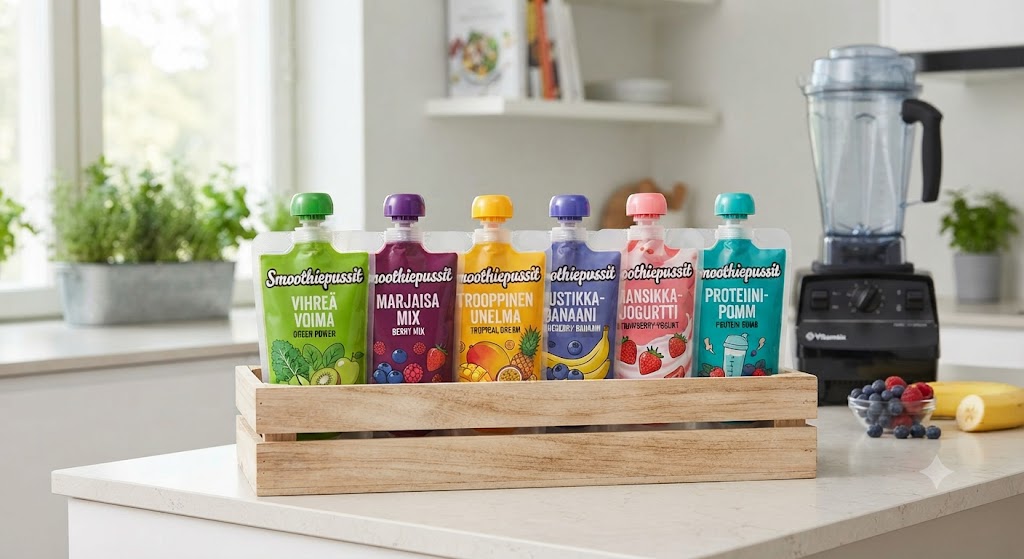
If you have recently encountered the word smoothiepussit online and wondered what exactly it means, you are not alone. The term has begun appearing across food, wellness, meal-prep, and lifestyle websites, usually in connection with smoothie pouches, smoothie bags, reusable squeeze pouches, and pre-portioned smoothie packs.
There is an important distinction, though. Smoothiepussit is not currently a universally standardized food-industry term with one authoritative definition. In practical online usage, it generally describes a convenient pouch-based system for preparing, storing, freezing, carrying, or consuming smoothies.
That simple concept can solve several surprisingly annoying problems. Fresh fruit spoils. Morning preparation takes time. Bottles occupy space. Homemade smoothies can be difficult to pack for children or travel.
Smoothiepussit offer another approach.
What Are Smoothiepussit?
In the most useful sense, smoothiepussit are smoothie pouches or bags used either to portion ingredients before blending or to store a prepared smoothie afterward.
Current usage generally falls into two categories.
Ready-to-blend smoothie packs contain measured ingredients such as berries, banana, mango, spinach, oats, seeds, or other additions. They are commonly prepared in advance, frozen, and emptied into a blender when needed.
Reusable smoothie pouches, meanwhile, hold a smoothie after it has been blended. These flexible containers typically have a drinking spout or cap and can be useful for lunches, snacks, travel, or portioning homemade purées.
Some products blur the distinction, which explains why search results for smoothiepussit can look confusing.
The important idea isn’t the terminology. It is the system: prepare once, portion intelligently, and make smoothies easier to use later.
What Does the Word Smoothiepussit Mean?
The unusual spelling is one reason the keyword attracts curiosity.
Several websites associate the expression with the Finnish word “pussit,” meaning bags, which makes “smoothie bags” a logical literal interpretation. However, because smoothiepussit has not developed a universally accepted commercial definition, shoppers should focus on what an individual product actually does rather than assuming every item carrying the term has identical features.
Depending on the context, you may see it associated with:
- reusable smoothie pouches;
- refillable squeeze pouches;
- freezer smoothie bags;
- pre-portioned frozen smoothie packs;
- fruit and vegetable purée pouches;
- portable smoothie containers;
- homemade snack pouches.
That broader definition makes more sense than treating smoothiepussit as a completely new kind of beverage.
Why Are Smoothiepussit Getting Attention?
Convenience is the obvious answer, but there is more going on.
A conventional homemade smoothie involves choosing ingredients, washing produce, chopping it, measuring extras, blending everything and cleaning afterward. None of those tasks is particularly difficult. Repeating them every morning is where friction appears.
Smoothiepussit shift part of that work to batch preparation.
Prepare several ingredient packs at the same time, and weekday smoothie preparation becomes much simpler. Alternatively, blend a homemade recipe and transfer suitable portions into reusable pouches for later use according to safe storage guidelines.
This system can appeal particularly to:
- busy households;
- parents preparing children’s snacks;
- commuters;
- students;
- people who meal-prep;
- gym-goers;
- travelers;
- anyone trying to use fresh produce before it spoils.
Convenience doesn’t automatically make a food healthier, of course. What matters is what goes inside the pouch.
Types of Smoothiepussit You Should Know
Understanding the format is more important than choosing something simply because it says “smoothie pouch.”
1. Freezer Smoothie Packs
These are arguably the simplest form of smoothiepussit.
Raw smoothie ingredients are portioned into freezer-compatible bags or containers. When it is time to make the drink, one portion goes into the blender with an appropriate liquid.
A basic pack might contain:
berries + banana + spinach
At blending time, you could add milk, a suitable plant-based beverage, yogurt, water, or another liquid depending on the recipe.
The advantage is speed. You make several ingredient decisions at once instead of repeating them every morning.
2. Reusable Smoothie Pouches
Reusable smoothiepussit are designed to hold already-blended food or drinks.
Many resemble refillable purée pouches, with a flexible body and capped spout. The exact construction varies significantly between manufacturers, so features such as freezer suitability, dishwasher compatibility and maximum temperature should always be checked against the manufacturer’s instructions.
These can be particularly practical when rigid bottles take up too much room.
3. Single-Use Smoothie Pouches
Ready-filled commercial smoothies and purées are often sold in disposable flexible packaging.
They’re extremely convenient, but single-use packaging creates a different sustainability equation from a pouch that is genuinely reused many times.
When comparing options, don’t rely on words such as “green,” “eco,” or “sustainable” alone. Look at material, durability, recyclability where you live, and realistic number of uses.
4. Silicone and Flexible Food Pouches
Some reusable pouches use silicone, while others use different food-contact plastics or multilayer constructions.
There is no universally “best” material for every household.
A good pouch is one that is appropriate for food contact, durable for its intended use, easy to clean thoroughly and used according to its manufacturer’s temperature and storage instructions.
Smoothiepussit vs. Ordinary Smoothie Bottles
A bottle remains an excellent option for many people. Smoothiepussit simply solve a different set of problems.
A rigid bottle generally holds its shape, can be easy to wash, and may handle repeated use very well. A flexible pouch, however, can become flatter as its contents are consumed and may occupy less room when empty.
For young children, a spouted pouch may also be easier to handle than an open cup.
But pouches have weaknesses.
Corners, seams and narrow openings can make cleaning more difficult. Thick smoothies can clog small spouts. Flexible containers may also be less convenient to stand upright while filling.
So the choice comes down to priorities.
Choose a pouch for compactness and squeeze-style convenience. Choose a bottle when effortless cleaning, rigidity and straightforward drinking matter more.
How to Make Smoothiepussit at Home
You don’t need an elaborate system.
The easiest approach is to build each frozen pack around a repeatable formula.
Step 1: Choose Your Produce
Start with fruits and vegetables that blend well.
Common choices include:
- banana;
- berries;
- mango;
- pineapple;
- peaches;
- spinach;
- kale;
- avocado.
Mixing ingredients is often more practical than throwing every “healthy” food you own into one pouch.
Flavor still matters.
Step 2: Think About Texture
This is where many homemade smoothie packs go wrong.
Banana, mango and avocado can add body. Berries provide stronger flavor and color. Leafy greens can work well in modest quantities.
Ingredients such as whole seeds, coarse oats or fibrous pieces can affect texture and may be unsuitable for a narrow drinking spout unless blended thoroughly.
Step 3: Portion Before Freezing
Divide ingredients according to the amount you normally blend.
This is one of the biggest practical advantages of smoothiepussit: portioning occurs when you have time, not when you are rushing out the door.
Avoid packing freezer bags so tightly that ingredients freeze into an inconvenient solid block.
Step 4: Label Everything
Write down at least:
recipe + preparation date
If you make several varieties, labeling prevents mystery bags from accumulating in the freezer.
It also helps you rotate older ingredients first.
Step 5: Add Liquid at Blending Time
For freezer ingredient packs, it is often easier to freeze the solid ingredients and add the liquid immediately before blending.
Start with less liquid than you think you need.
You can always add more. Removing excess liquid from an overly thin smoothie is considerably harder.
How to Build a More Balanced Smoothie
A smoothie can contain nutritious foods without automatically being a nutritionally balanced meal.
Fruit-heavy blends, for example, can be easy to drink quickly while providing less satiety than expected. Instead of judging a smoothie by its color or number of “superfoods,” think about its overall composition.
Depending on your dietary needs, a smoothie might combine:
Produce: berries, banana, mango, spinach or another fruit/vegetable.
Protein source: yogurt, milk, soy beverage or another suitable ingredient.
Fat and texture: nut or seed butter, avocado, chia or another appropriate addition.
Liquid: water, milk or a suitable alternative.
Needs differ by person. Allergies, age, dietary restrictions, medical conditions and nutrition goals can all change what belongs in a smoothie.
That is why smoothiepussit should be viewed as a storage and preparation format, not a health claim.
Food Safety Matters More Than Convenience
This is an area many superficial smoothiepussit guides overlook.
A reusable pouch comes into direct contact with moist food. Smoothies can also contain dairy products, plant-based beverages, fresh produce and other perishable ingredients.
Good hygiene therefore matters.
Wash reusable pouches according to their manufacturer’s directions and make sure food residue is removed from seams, corners, caps and spouts. Allow components to dry properly before storing them.
Prepared smoothies containing perishable ingredients should not simply sit at room temperature for long periods. Refrigerate promptly and follow established food-safety guidance for the ingredients you use.
If a reusable pouch becomes damaged, develops difficult-to-clean areas, retains odors despite proper washing, or can no longer seal reliably, replacing it may be more sensible than trying to extend its lifespan indefinitely.
How to Choose Good Smoothiepussit
Marketing photos tell you almost nothing about how practical a pouch will be after 20 uses.
Pay attention to design instead.
A Wide Filling Opening
A larger opening makes it easier to transfer thick smoothies without covering the kitchen counter in berry purée.
It can also make cleaning easier.
A Reliable Seal
A portable pouch that leaks isn’t portable.
Inspect the closure system carefully, particularly if the pouch will travel inside a school bag, handbag, backpack or lunch box.
Easy-to-Clean Construction
Look at the corners.
Can you realistically reach every internal surface? Are there narrow seams where food could become trapped?
A clever-looking pouch that is frustrating to clean may eventually stop being used.
Appropriate Capacity
Bigger isn’t automatically better.
Choose a capacity suited to the person and purpose. A child’s snack and an adult post-workout smoothie are obviously different use cases.
Clear Manufacturer Instructions
A trustworthy product should clearly explain important limitations.
Check whether the pouch is intended for the freezer, refrigerator, dishwasher, microwave, or other temperature conditions before using it that way. Never assume those features merely because another pouch looks similar.
Common Smoothiepussit Mistakes
The system is simple, but a few errors can make it unnecessarily frustrating.
Overfilling the pouch: Leave enough room to close it properly and account for the manufacturer’s freezing instructions where applicable.
Making the blend too chunky: Narrow spouts and fibrous ingredients aren’t always friends.
Ignoring the closure: Test reusable pouches at home before trusting one next to a laptop or school books.
Buying too many immediately: Start with a small number. See whether the format actually fits your routine.
Confusing convenience with nutrition: A pouch doesn’t improve the nutritional quality of what’s inside it.
Neglecting cleaning: Smoothie residue hiding around a cap or seam defeats the purpose of a reusable container.
Can Smoothiepussit Reduce Food Waste?
Potentially, yes—but only when the system changes how you use food.
Imagine you bought too many berries and several bananas are ripening simultaneously. Portioning suitable produce into smoothie packs before it spoils can give those ingredients another planned use.
That’s practical food-waste prevention.
The same logic applies to spinach or other smoothie-friendly produce that you know you will not consume fresh in time, provided it is still safe and suitable for freezing.
The important word is planned.
Buying extra ingredients specifically to fill a freezer with forgotten smoothie bags does not reduce waste. It simply moves the waste from the refrigerator to the freezer.
Are Reusable Smoothiepussit Really Sustainable?
Not automatically.
Reusable products have an environmental advantage only when they are actually reused enough to justify their production, cleaning and eventual disposal.
A durable pouch used repeatedly is a very different proposition from a reusable pouch purchased, forgotten in a drawer and discarded after two uses.
Before buying, ask:
- Will I genuinely use this every week?
- Can I clean it easily?
- Is it durable?
- Does it replace something disposable?
- Is the material suitable for my intended use?
- What happens when it reaches the end of its useful life?
Sustainability is a lifecycle question, not a label printed on packaging.
Who Can Benefit Most From Smoothiepussit?
Smoothiepussit are particularly useful when portability or advance preparation is the actual problem.
For a parent, that may mean packing a homemade blended snack.
For an office worker, it could mean preparing smoothie ingredients on Sunday so breakfast takes less effort during the week.
For someone going to the gym, a reusable pouch might offer a compact way to carry a suitable blended snack.
For a household trying to waste less produce, freezer packs can provide a planned destination for ingredients before they deteriorate.
If you already make and drink a smoothie at home every morning without difficulty, however, you may not need a pouch at all.
Good systems solve real problems. They shouldn’t manufacture new ones.
The Future of Smoothie Pouches
Portable food packaging is evolving as consumers, manufacturers and regulators pay closer attention to packaging waste, food safety, recyclability and reuse.
That makes the broader concept behind smoothiepussit relevant beyond a passing keyword trend.
Future designs are likely to compete on practical features such as durability, easier cleaning, improved seals, material transparency, recyclability and genuinely useful reusable formats.
The winning products won’t necessarily be the most visually impressive.
They’ll be the ones people continue using.
Frequently Asked Questions About Smoothiepussit
What exactly are smoothiepussit?
Smoothiepussit is an emerging term most commonly used online for smoothie bags, pre-portioned smoothie packs, or reusable smoothie pouches. Depending on context, the pouch may hold ingredients before blending or a prepared smoothie afterward.
Because the term does not have one standardized product definition, check the specific product or recipe being discussed.
Are smoothiepussit the same as smoothies?
Not exactly.
A smoothie is the blended food or beverage itself. Smoothiepussit generally refers to the pouch, bag or preparation format associated with storing smoothie ingredients or carrying the finished blend.
Can you freeze smoothiepussit?
Freezer smoothie ingredient packs are specifically built around freezing ingredients in advance. Reusable drinking pouches, however, vary.
Only freeze a particular pouch when its manufacturer confirms that the material and closure are freezer-safe, and follow instructions concerning fill levels and temperature.
Are reusable smoothie pouches safe for children?
Products intended for children should be age-appropriate and used according to the manufacturer’s instructions. Pay particular attention to caps, detachable components, material specifications, cleaning and supervision recommendations.
Homemade contents should also be suitable for the child’s age, allergies and dietary requirements.
How do you clean reusable smoothiepussit?
Empty the pouch promptly and follow the manufacturer’s cleaning instructions. Pay special attention to the spout, cap, seams and corners where thick smoothie residue can remain.
Allow all parts to dry properly before storage. If residue cannot be removed reliably or the pouch becomes damaged, discontinue use.
Final Thoughts: Make Smoothiepussit Work for Your Routine
The interesting thing about smoothiepussit isn’t the unusual name. It’s the practical idea behind it.
By combining batch preparation, portion control, compact storage and portable smoothie pouches, the system can remove some of the friction that prevents people from using fresh ingredients consistently.
But keep expectations realistic. A pouch doesn’t automatically make a smoothie nutritious, sustainable or safe. Ingredient quality matters. Food handling matters. Product design matters. And reusable packaging only earns its name when you actually reuse it.
Start small.
Prepare two or three freezer smoothie packs using ingredients you already enjoy, or test a well-designed reusable pouch that suits your routine. Label your batches, follow food-safety and manufacturer guidance, and pay attention to how easy the system is to clean and maintain.
If it saves time without creating extra hassle, keep using it.
That’s where smoothiepussit become genuinely useful: not as another wellness trend, but as a simple tool that makes a good habit easier to repeat.