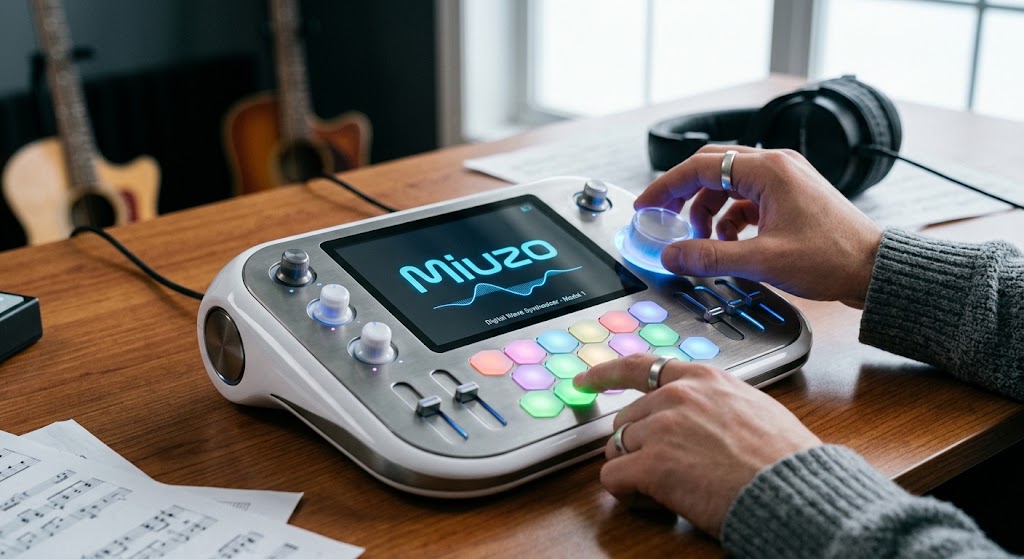
Miuzo is attracting growing search interest, but there is an unusual problem: different websites describe it as completely different things. Depending on which result you open, you might read that it is an AI platform, a productivity workspace, an electronics brand, a digital-identity concept, or even sports-performance technology.
Those descriptions cannot simply be combined into one neat definition. Current search results show substantial disagreement about what the name represents, while the clearest exact-match web property, Miuzo.org, presents a much broader informational identity rather than clearly validating many of the specific products and services attributed to the term elsewhere.
That distinction matters.
Rather than repeating an attractive but potentially unsupported story, this guide examines what can actually be established, why the keyword has become ambiguous, how to evaluate websites or services using the name, and what the evolving search landscape tells us about its digital identity.
What Is Miuzo?
At the moment, Miuzo does not have one consistently verified definition across authoritative online sources.
This is the most useful starting point for anyone researching the term. Several publishers describe it confidently, but their descriptions frequently conflict with one another.
One source presents the term as a broad digital-identity concept associated with creative expression and branding. Another portrays it as a modern productivity platform. A different publication calls it a consumer-electronics brand selling personal audio equipment, while still others associate the name with artificial intelligence, automation, cloud systems, or digital collaboration.
The contradiction is significant because a real, established commercial entity would normally leave a reasonably coherent trail: official product documentation, corporate information, application-store listings, product specifications, support resources, pricing pages, regulatory information, or consistent first-party descriptions.
Public search results currently provide a much less unified picture.
So the most accurate answer to “What is Miuzo?” is contextual: you need to identify which website, article, account, product, or project is using the name before deciding what it means.
Why Is Miuzo Suddenly Appearing in Search Results?
Search demand often grows around unfamiliar words precisely because people do not know what they mean.
Someone sees an unusual name in an article, social post, domain, advertisement, or recommendation. They search it. Publishers notice that search demand and create explanatory content. More pages appear, leading even more people to assume there must be a specific established concept behind the keyword.
That feedback loop can develop surprisingly quickly.
Recent search results demonstrate exactly this kind of fragmentation. Articles published during 2026 have variously characterized the term as a digital platform, branding concept, AI ecosystem, productivity tool, electronics company, and broader technology trend.
This creates what SEO professionals might call entity ambiguity.
Google is not merely trying to match a string of letters. Search systems attempt to understand which real-world entity, topic, organization, product, or concept a user means. When sources themselves disagree, establishing that entity becomes much harder.
For readers, that means one rule should come before everything else:
Do not confuse search-result repetition with verification.
Understanding the Miuzo.org Online Presence
Miuzo.org is currently one of the clearest exact-match web properties connected to the keyword. However, its publicly indexed presentation does not cleanly match many of the highly specific product descriptions appearing elsewhere.
Recent analysis of the domain describes it as a broader informational destination associated with innovation, technology, education, smart solutions, and general online topics. Its content footprint appears closer to an editorial or informational website than to a narrowly defined SaaS product, electronics manufacturer, or specialized AI service.
That does not automatically invalidate every other use of the word. Different organizations, creators, or projects can use similar or identical names.
It does mean that readers should avoid assuming that every article mentioning Miuzo is talking about the same entity.
Is Miuzo a Software or Productivity Platform?
Some pages describe the name as a centralized digital workspace intended to combine tasks, files, communication, collaboration, creativity, or other productivity functions.
For example, TechShali portrays it as a workspace that brings tasks, files, and team discussions into one environment. Radar Magazine similarly characterizes it as a productivity and collaboration platform.
Other publications go considerably further, describing financial tools, AI assistance, creative workflows, personal development functionality, and future integrations.
The important question is not whether these descriptions sound plausible.
It is whether they can be connected to primary product evidence.
Before accepting claims about project management, AI automation, integrations, pricing, mobile apps, financial functionality, or collaboration features, look for an identifiable official product environment, documentation, terms of service, release information, verified demonstrations, or company-owned support pages.
Without those signals, detailed third-party descriptions should remain claims rather than facts.
Is Miuzo an AI Tool?
Artificial intelligence is one of the strongest semantic themes surrounding the keyword.
Various recent pages connect the name with AI automation, machine learning, predictive analytics, personalization, SaaS infrastructure, cloud collaboration, workflow optimization, and intelligent digital ecosystems. One article explicitly concludes that the current search landscape presents the term more consistently as a broad technology-related concept than as a clearly verified global software platform.
That is an important distinction.
There is a massive difference between saying, “online discussions associate the term with AI,” and saying, “this is a verified AI platform with these specific capabilities.”
The first statement describes observable search behavior. The second requires evidence about an actual product.
For that reason, searches such as Miuzo AI, Miuzo AI platform, Miuzo automation, and Miuzo technology should be approached with a verification mindset rather than assuming that every feature list found in an article represents official software documentation.
Is Miuzo an Electronics Brand?
Another competing narrative describes the name as a consumer-electronics brand specializing in affordable wireless earbuds, headphones, and related accessories.
A May 2026 article, for example, discusses Bluetooth audio products and positions the supposed brand against established manufacturers such as Sony, Bose, and Apple.
The problem is that this identity is not consistently reflected across the wider search landscape.
If you encounter a physical product carrying the name, verify the product itself instead of relying on generic brand articles. Manufacturer identity, exact model numbers, warranty terms, technical specifications, certification markings, retailer reputation, return policies, and genuine customer-support channels are considerably stronger evidence.
A polished blog post is not a substitute for a product trail.
Miuzo as a Digital Identity and Brandable Name
One of the less assumption-heavy interpretations is that the word functions as an abstract digital identity or coined brand name.
Several publications describe it in precisely those terms: a distinctive expression without an established dictionary meaning that can acquire meaning through repeated use, branding, community association, or a particular digital project.
That interpretation makes sense from a branding perspective.
Coined names have a strategic advantage: they begin with relatively little semantic baggage. A company called “London Budget Headphones,” for instance, immediately ties itself to a location, price position, and product category. A made-up brand can theoretically expand into entirely different categories without the original name becoming awkward.
But abstraction creates work.
A descriptive name tells customers what a company does immediately. An invented name must build that association through positioning, visual identity, customer experience, content, public relations, product quality, and consistent entity signals.
The word provides the container. The brand must supply the meaning.
Why So Many Conflicting Definitions Exist
The Miuzo search landscape is a useful example of how uncertain information can become amplified online.
Once a low-competition or emerging keyword begins receiving attention, publishers have an incentive to answer the resulting query. One source assigns the term a meaning. Another expands that explanation. Subsequent articles may combine those descriptions with broader technology trends.
Eventually, the SERP can contain several detailed narratives even when the underlying primary evidence remains thin.
Current results demonstrate this effect unusually well:
- Some sources frame the term around digital identity and creative branding.
- Others describe productivity, task management, and collaboration software.
- Several connect it with AI, automation, analytics, and cloud technology.
- At least one source positions it as a consumer audio and electronics brand.
- Another presents it as sports-performance technology involving AI.
- Miuzo.org itself appears to have a considerably broader informational or editorial footprint than many of those descriptions suggest.
That contradiction is more informative than any single speculative definition.
It tells readers that the entity has not yet become sufficiently clear for every search result to be treated as referring to the same thing.
How to Verify Miuzo Before You Trust a Claim
A sensible verification process starts with source proximity.
The closer a source is to the product or organization being discussed, the better positioned it usually is to establish basic facts such as features, ownership, pricing, terms, and specifications. Independent sources remain valuable for reviews and criticism, but they should not be the sole evidence that a product even exists in the form being described.
When evaluating a site, app, product, or service using the name, check official documentation, ownership information, privacy policies, terms of service, real contact channels, app-store publisher identity, exact product models, warranties, independent reviews, secure payment infrastructure, and consistent branding across verified accounts.
Watch for contradictions too.
If one article says a platform is primarily an AI SEO assistant while another says the same name belongs to wireless headphones, you should not quietly combine those claims. Ask whether they concern separate entities—or whether one or more descriptions lack adequate evidence.
That habit is valuable far beyond this keyword.
Is Miuzo Safe and Legit?
There is currently no defensible way to assign one universal safety rating to every site, product, or service operating under this name.
Why? Because the underlying entity itself remains ambiguous.
A website may be legitimate while an unrelated download using a similar name is unsafe. Likewise, a genuine physical product does not automatically establish that a similarly named software service belongs to the same organization.
For any unfamiliar platform, evaluate the actual destination you intend to use.
Check domain spelling carefully, read its privacy policy, inspect what information it requests, research company ownership where available, verify payment protections, and avoid installing executable files from untrusted third-party sources.
If money, personal data, credentials, cryptocurrency, business information, or sensitive files are involved, the verification threshold should be considerably higher.
Miuzo vs. Mizuno and Meizu: Check the Spelling
A surprisingly practical search issue is name similarity.
Mizuno is a well-established Japanese sporting-goods company associated with footwear, apparel, running, golf, baseball, and other sports categories. Meizu, meanwhile, is a technology brand known for smartphones, software, AI-oriented devices, and related consumer technology.
Those names should not automatically be treated as variants of Miuzo.
Search engines sometimes infer spelling corrections or surface semantically similar entities when a query is uncommon. A user moving quickly through results could therefore end up reading specifications, reviews, company histories, or support information concerning a completely different brand.
Always confirm the spelling before acting on what you find.
What the Search Landscape Reveals About Modern SEO
This keyword offers an unusually clear lesson in semantic SEO and E-E-A-T.
Strong content is not the page that repeats a keyword most often. It is the page that best resolves the user’s uncertainty.
For a poorly defined entity, that means acknowledging conflicts, distinguishing primary evidence from secondary interpretation, identifying what is known, identifying what remains uncertain, and helping readers make better decisions.
That is genuine information gain.
It also addresses search intent at multiple levels. Someone may arrive asking for a definition, but their next questions will naturally involve legitimacy, use cases, software, AI, products, safety, ownership, or whether similarly named brands are connected.
An authoritative resource should anticipate those questions instead of inflating an uncertain concept into a fictional certainty.
What Could Happen Next?
The meaning of Miuzo may become much clearer over time.
If one company or project develops a strong official presence, publishes transparent documentation, earns independent coverage, creates recognizable products, and builds consistent brand signals across the web, search engines can begin consolidating the term around that entity.
Search intent would change with it.
Instead of predominantly informational queries such as “what does this mean?”, people might search for pricing, login pages, product reviews, tutorials, alternatives, integrations, support, or purchase options.
Alternatively, the term may continue to be used by unrelated projects.
That possibility is why future readers should rely on current evidence, not assumptions inherited from older articles.
FAQ About Miuzo
What is Miuzo in simple terms?
Miuzo is an ambiguous online term that currently appears in several unrelated contexts. Some publishers describe it as technology or software, while others associate it with branding, artificial intelligence, electronics, productivity, or creative digital identity.
The correct meaning therefore depends on where you encountered the word. Check the specific domain, company, application, product, or account before treating any broader definition as definitive.
Is Miuzo a real company?
Public search results do not currently provide one clear, universally consistent corporate identity behind every use of the name.
An exact-match website exists at Miuzo.org, but its indexed footprint is broader and more editorial than many third-party descriptions of specialized software or hardware would suggest.
If you are evaluating a specific company using the name, verify its legal business details, official website, ownership information, products, policies, and contact channels independently.
Does Miuzo have an official app?
Current search evidence does not provide enough consistent primary documentation to confidently identify one universally recognized official app connected to every use of the term.
Be cautious with downloads claiming to be an official application. Verify the developer or publisher directly through a trusted app marketplace and compare that identity with the organization’s verified website before installing anything.
Is Miuzo an AI platform?
Some online publishers associate the term strongly with artificial intelligence, automation, personalization, analytics, and digital workflows. Other sources, however, give it completely different definitions.
It is therefore more accurate to say that AI is one prominent theme in current online discussions than to state categorically that every reference to the term denotes one verified AI product.
Why is Miuzo becoming popular?
Curiosity appears to be an important driver.
The unusual name has generated explanatory articles across technology, branding, productivity, and digital-culture websites. Because those articles often disagree about its meaning, users have an additional reason to search for clarification.
This can create a self-reinforcing search cycle: ambiguity generates searches, searches generate content, and new content generates additional curiosity.
Final Verdict: How to Approach Miuzo
The most important thing to understand about Miuzo is not a feature list or marketing promise. It is that the term currently carries multiple competing online identities, and available search evidence does not justify merging all of them into a single platform, company, product, or technology.
That uncertainty is useful information.
If you encounter the name attached to an AI tool, electronics product, website, productivity platform, download, or business opportunity, identify the exact entity first. Then verify the claim through first-party documentation and credible independent evidence before purchasing anything, providing personal information, installing software, or relying on technical specifications.
Your next step is simple: bookmark the exact page or product where you encountered the term, verify who operates it, and compare its claims against primary documentation. That will give you a far more reliable answer than assuming every search result describes the same thing.